Showing posts with label macroeconomics. Show all posts

Sunday, 18 October 2026

Microfoundations and the DSGE paradigm: Don't Say Goodbye to Evidence

Robert Hall and Michael Woodford are worthy recipients of the Nobel Memorial Prize in Economic Sciences, reflecting the profound influence their work has had on modern macroeconomics. They won the award for contributions to models built on microfoundations, capturing how individual agents’ actions affect macroeconomic outcomes; Woodford’s work is rooted in New Keynesian economics whereas Hall’s has a more empirical thrust. The citation stated that they “have developed new macroeconomic models that have significantly improved our ability to implement effective stabilisation policy [which] can reduce the economy’s peaks and troughs.” The effectiveness of these models is debatable, but the importance of individual decisions to macroeconomic outcomes is not.

While the intellectual ambition behind their work deserves recognition, I have reservations about the direction the discipline has taken in its wake. Indeed, when the Committee’s detailed assessment of their work claimed that the DSGE models resulting from this paradigm “turned out to be of great practical use, as [they] helped steer the economy onto the right path” after the 2008 recession, my antennae started to twitch. The standard models at that time did not incorporate a financial sector – they lacked a mechanism to evaluate policies such as bank recapitalisation and asset purchases, which were among the tools used to promote the post-2008 recovery. Although some models incorporated financial frictions, these were not adequately represented in many of the models central to the pre-crisis consensus.

This is no criticism of the recipients – they did not write the citation after all – and I have great respect for the intellectual abilities of Professors Hall and Woodford. But I have previously expressed reservations about microfounded DSGE models (here, for example) and the imprimatur of a Nobel award does not change my view. Microfounded models are intellectually sophisticated but their tractability often comes at the cost of assumptions that are difficult to reconcile with reality, while their forecasting performance has not clearly surpassed that of the semi-structural models they displaced.

The words of economist Mikhail Dmitriev in a LinkedIn post captured my views rather well: “the field seems to have reached something of an intellectual dead end. Michael Woodford's work … helped establish a powerful and mathematically rigorous framework that shaped decades of research. At the same time, I wonder whether the dominance of this framework has unintentionally narrowed the range of questions, methods, and ideas explored in mainstream macroeconomics. In terms of influence on the field, the prize is entirely deserved. But influence and progress are not necessarily the same thing. It is worth asking whether the intellectual direction that followed has ultimately brought us closer to understanding the real economy.”

Key criticisms of the microfoundations debate

Much of modern mainstream macroeconomics requires aggregate relationships to be derived from the optimising decisions of individual agents. The result is elegant, internally coherent models. But coherence is not the same as explanation, and the requirement has narrowed the range of acceptable answers without clearly improving empirical relevance or predictive power. The point of contention is not whether macroeconomic models should be informed by microeconomic behaviour, but whether every aggregate relationship must be derived from a particular form of individual optimisation, typically combined with rational expectations and equilibrium conditions. These are methodological issues and are not necessary conditions for microfounded analysis. 

Such models are based on the assumption of rational, forward-looking agents who understand their economic environment, form expectations about the future and optimise accordingly. But how do agents form expectations when the future is fundamentally uncertain? Rational expectations impose consistency between agents' expectations and the model, given the information available. But this does not establish that people actually form expectations in this way, particularly when they do not know the “correct” model of the economy. This apparent rigour conceals the arbitrariness of some of the underlying assumptions.

As I noted in my previous post, representative agent models do not capture the differences in household incomes and wealth that have a profound impact on macro outcomes. Nor do they account for financial constraints, market power and strategic interactions. Much of microfounded literature thus ignores the factors that make macro analysis both difficult and endlessly fascinating. The development of heterogeneous-agent models has helped address some of these shortcomings, but it also illustrates how much the results can depend on assumptions about behaviour and the distribution of economic resources.

Moreover, insisting that every relationship comes from an explicit optimisation problem encourages elaborate models whose conclusions depend heavily on functional forms and preference assumptions. Observed statistical relationships may be more stable, and more useful for forecasting, than structural equations derived from a particular theory. A relationship is not scientifically inferior merely because it was estimated rather than derived from first principles.

The literature also downplays institutional factors.  Corporate behaviour depends on factors such as governance, financing arrangements, market structure, bargaining power and uncertainty about demand. Wage formation reflects institutions and social norms, not just the solution to an optimisation problem. These features can be incorporated into microfounded models. But the more they have to accommodate institutions, conventions and changing behaviour, the less convincing the claim becomes that a single, narrowly specified form of microeconomics provides the necessary foundation for macroeconomic analysis.

Finally, and as noted by Mikhail Dmitriev above, other approaches to macroeconomics have been crowded out. Methods built on empirical regularities and econometric relationships do have their place, which gives an important role to semi-structural models. Less mainstream methods such as institutional analysis and stock-flow consistency are also increasingly acknowledged to be important, particularly in the field of finance. Stock-flow-consistent models, for example, ensure that flows of income and expenditure are consistent with the associated changes in financial assets and liabilities, helping to expose balance-sheet relationships that can be overlooked in more stylised frameworks.

Was Lucas right?

One of the reasons why the microfoundations field gained such traction was the criticism aimed by Robert Lucas – himself a Nobel Prize recipient – that estimated macro relationships can shift when policy regimes change. He was right about that, but we should not allow this to exercise a methodological veto over a lot of conventional econometric models. Indeed, microfounded models are not exempt from structural change, since their results depend on preferences, constraints and expectations that may themselves shift. The sensible response is to test for instability, investigate mechanisms and assess forecasting performance, not to assume theory-derived relationships are inherently policy-invariant.

Rational expectations became a central part of the response to the Lucas critique, by making agents' expectations consistent with the model they inhabit. But as I noted in this post, agents can behave sensibly given their information without knowing what is the “correct” model of the economy. They learn from experience, follow rules of thumb, imitate others and revise expectations as circumstances change. In an environment of change, an adaptive process may be more convincing than a fixed model of expectations. Rational expectations often assume away the biggest difficulty agents face: making decisions in a world whose structure they do not fully understand. Too often modern macroeconomics treats such fundamental uncertainty as a computational inconvenience, when in reality it is a core aspect of decision making.

It has not been all bad

We should, of course, acknowledge the good things that have emerged from the microfounded literature, which has provided some discipline on the macro field. Woodford’s framework and Hall’s empirical work provide a foundation on which more useful models may yet be built. The post-2008 move away from representative agent to heterogeneous agent models, prompted by evidence that households have very different marginal propensities to consume, challenged the assumption that a single representative household could adequately capture aggregate behaviour. And perhaps AI-based agents will prove to be another step on the road to better economic understanding.

Nor should we dismiss the Lucas critique. The experience of the Phillips curve provides some support for its central insight: the relationship between inflation and economic activity depends partly on how expectations are formed and how monetary policy is conducted. The breakdown of the original inflation-unemployment trade-off during the 1970s, when inflation expectations became less firmly anchored, and the subsequent flattening of the Phillips curve as monetary policy gained credibility, are consistent with Lucas’s proposition. This does not prove that rational expectations is the correct description of behaviour, or that microfounded models are necessarily superior. But it does suggest that models which treat historically estimated relationships as invariant can be misleading when used to assess changes in policy.

Moreover, Woodford’s work highlights the importance of a coherent welfare criterion. This was lacking in previous frameworks, so optimal-policy analysis was less well defined. Microfounded models have made welfare-based policy analysis more systematic by linking policy choices to the preferences and constraints of economic agents. Whether the criterion is reliable is another matter, since the output gap is unobservable and r* is poorly estimated in real time.

Last word

One of my biggest criticisms of the literature is that microfoundations create incentives to choose assumptions that make models mathematically manageable. The framework can then become a description of what economists know how to solve rather than a convincing representation of the economy. By ignoring financial crises and institutional change, we create stylised models that reflect the world as economists would like it to be, rather than how it is in reality.

This is not to say we should abandon microfoundations but the test of a macro model should be whether it helps us understand economic outcomes, forecast developments and assess policy. Recognition for an important intellectual contribution does not settle that methodological question. Indeed, Lawrence Klein received his Nobel Prize in 1980 “for the creation of econometric models and the application to the analysis of economic fluctuations and economic policies.” Within the next decade, much of the profession had abandoned the foundations of the large-scale structural models he pioneered, in favour of rational expectations and microfounded alternatives. Nobel recognition marks a contribution’s importance, not the permanence of its methods.

Saturday, 21 February 2026

Deindustrialisation: The rights and wrongs


Marco Rubio’s speech at the Munich Security Conference last weekend was greeted with relief in some quarters for being less bombastic than JD Vance’s aggressive speech in 2025. But in many ways, the underlying message was the same and it did nothing to dissuade the audience that the United States and Europe have fundamentally different geopolitical views and interests. Nonetheless, the speech was interesting and contained some points I agreed with, many that I disagreed with, and one in particular that touched on an economic issue worthy of further thought.

Was deindustrialisation inevitable?

Rubio opined that “Deindustrialization was not inevitable.  It was a conscious policy choice, a decades-long economic undertaking that stripped our nations of their wealth, of their productive capacity, and of their independence.  And the loss of our supply chain sovereignty was not a function of a prosperous and healthy system of global trade.  It was foolish.  It was a foolish but voluntary transformation of our economy that left us dependent on others for our needs and dangerously vulnerable to crisis.”

In my view, the idea that “deindustrialization was not inevitable” is both right and wrong. In order to unpack this, we should recall that the prevailing economic model across the Anglo-Saxon world from the 1980s onwards was heavily influenced by the ideas of Milton Friedman and the Chicago School. They strongly argued that markets allocate resources more efficiently than governments, and that shareholder primacy and capital mobility were normal features of a globalising economy. In order to make this model work, financial markets were deregulated and capital markets became increasingly global in scope. Firms came under strong pressure to relocate production to lower-cost jurisdictions, automate labour-intensive processes and shed capacity that no longer met required rates of return.

Trade barriers were lowered, partly through the completion of the EU single market, but most importantly as a result of China’s accession to the WTO in 2001. And who was the prime advocate of that accession? None other than the United States. However, the result was that in a world of falling trade barriers and increasingly rapid technological change, maintaining high-cost domestic manufacturing often meant either accepting lower profitability or subsidising inefficiency. Detroit’s decline was not wholly due to the inexorable rise of Shiyan – it was aided and abetted by government policy.

But while deindustrialisation was a consequence of governmental decisions, voters also expressed a clear preference for this model. Resources were reallocated towards sectors in which advanced economies enjoyed a comparative advantage – finance, high-value services, technology and knowledge-intensive activities – while production was outsourced to regions which enjoyed lower costs. As a result, consumers benefited from lower-priced goods. After the inflationary turmoil of the 1970s, voters supported policies that prioritised price stability, efficiency and consumer welfare. To that extent, the economic settlement reflected societal preferences as well as political ideology. It was as much a reflection of societal choice as a policy imposed by governments.

We are paying a price

Unfortunately, the gains from a relatively laissez faire policy were unevenly distributed. Indeed, many of us have long argued that the pace at which large parts of the western world deindustrialised, particularly the UK, was always going to create the left-behind communities that politicians now struggle to engage with. Labour was far less mobile than capital, with the result that workers in former industrial regions could not simply retrain overnight or relocate at negligible cost. Skills were industry-specific; social networks were geographically rooted and housing markets were illiquid. What appeared as efficient reallocation in the macro numbers manifested locally as long-term unemployment, wage stagnation, deteriorating public services and social fragmentation.

Although the economic orthodoxy of the time assumed that the operation of market forces would generate new opportunities which would ultimately absorb displaced labour, the duration of the adjustment process was underestimated. In short, while deindustrialisation was perceived as economically rational, it was never economically costless. Perhaps the real problem was the absence of subsequent government engagement. Communities were told that there was nothing that governments could do to prevent the forces of globalisation ripping old industries apart and that they would have to reinvent themselves or face the consequences. Some of the old industries were admittedly unsustainable – coal mining for one – but governments could have done more to cushion the blow for other industries. In the UK, the government blew the windfall gains from oil revenues on tax cuts, rather than building a fund that could have provided support to those communities disadvantaged by the switch from coal to oil.

Thus, while countries such as Norway used resource windfalls to build long-term stabilisation mechanisms, the UK opted for rapid liberalisation with comparatively limited regional industrial policy. A similar position was adopted in the US. Successive governments ignored the fact that while many of the structural forces driving deindustrialisation were powerful and perhaps unavoidable to some degree, they gave little thought as to how society should manage the transition. This, in my view, is why you can debate Rubio’s position from both sides. Deindustrialisation can be seen as a response to the turmoil of the 1970s. We could have struggled on, supporting old industries in a stagnant economy. But the good times of the late-1980s and 1990s would not have happened, and China would have industrialised anyway. Or governments could attempt to fix things – which they did, albeit imperfectly.

Deindustrialisation and parallels with the AI revolution

Advances in AI threaten to unleash even more economic turmoil, for which governments around the world are woefully unprepared. If this popular essay is any guide, the AI models available today are “unrecognizable from what existed even six months ago ... ” and they are coming for your job. This excellent paper by Charles Jones (well worth a read) argues that “AI will likely be the most important technology we have ever developed” and poses the question “What if machines … can perform every task a human can do but more cheaply?” The object here is not to debate what AI can do, nor whether it will replace human labour (we can deal with that issue another time). The more immediate point is that transformative technologies have the power to reshape economies and societies at extraordinary speed. If the risks appear large enough, perhaps we should be trying to pause or even halt the process. But is that remotely feasible? Can you imagine the political backlash from figures such as Rubio if governments were to act in such a way?

The deeper issue is not whether we should stop AI, but whether we could. Once a technology offers clear economic, strategic or military advantages, it acquires a momentum of its own. No major economy can afford to fall behind; no government wishes to explain why it chose restraint while rivals accelerated. In that sense, technological change is not always a policy choice. It can become a structural inevitability. Deindustrialisation in advanced economies forty years ago followed just such a path. It was politically contentious and socially painful, yet in a world of global competition and mobile capital it proved effectively irreversible. AI may represent a similar moment. The real danger lies not in the technology itself but in the illusion that it can be switched off. The task for policymakers is not prevention, but preparation because history suggests that once transformation begins, it rarely asks permission.

Last word

Precisely because the combination of technology and politics is a process rather than a discrete choice, Rubio is wrong to suggest that deindustrialisation was simply a matter of political will. It represented the cumulative consequence of a policy regime that prioritised capital mobility, trade liberalisation and financial integration. It is true that governments could have done more to mitigate the costs, but once advanced economies committed to that path the industrial base adjusted accordingly. At that point, reversal would have required costs and disruptions far greater than those incurred by continuation. What began as a series of policy choices hardened into economic structure.

AI may follow the same trajectory. Early regulatory decisions matter, but once firms – and indeed wider society – reorganise production around algorithmic systems and autonomous capabilities become embedded, restraint becomes extraordinarily costly. The question is not whether policymakers approve of the direction of travel, but whether they are prepared for its consequences. As of now, they are not. It is important to be aware of this because, when future politicians tell us of the mistakes our society made, we should remember that many of the choices made were not ours to take.


Friday, 25 July 2025

Rationality meets reality

 The rational expectations (RE) revolution which swept through macroeconomics in the 1970s and 1980s has changed the way we think about many aspects of macro. As theories go, it is coherent and persuasive and has allowed us to think differently about many aspects of economics and finance. But there have been rumblings recently from respected professionals in the field expressing doubts about its usefulness. As one who has never fully bought into the idea that this is actually how people form expectations, I am obviously prone to confirmation bias, but clearly I am not the only one who has reservations about one of the key underpinnings of modern macroeconomics.

What are rational expectations?

In very simple terms, RE assumes that economic agents make the best use of all currently available information to make predictions about future events in a logically consistent manner. The upshot is that individuals do not make systematic forecast errors (although they can make random errors). This appears uncontroversial at first glance but it has profound consequences for policymakers. Prior to the work of Robert Lucas in the 1970s, it was assumed that a paradigm used to assess the outcome of a policy change would either remain unchanged in future, or would change only slowly as expectations adapted to new evidence. But Lucas pointed out that as economic agents recognise and internalise the way policy affects the economy, they will change their expectations formation process. As a result, the old paradigm is no longer valid. Applying the same policy options in future would result in different outcomes because agents would anticipate what was likely to happen and act accordingly.

A simple example is the  Phillips curve, which was based on the idea that there is a stable and exploitable inverse trade-off between inflation and unemployment. In this static world, a policymaker wishing to reduce unemployment would be prepared to allow inflation to rise. But in a world where expectations are formed rationally, they can only get away with that once.  Next time round workers push for higher wage claims to offset the erosion of real wages, with the result that employment falls (unemployment rises). As it happened this was pretty much what happened in the 1970s as the inverse relationship between the two broke down.

Lucas led the intellectual charge of New Classical economics which usurped the dominant Keynesian paradigm, and challenged the efficacy of discretionary macroeconomic policies by arguing that if individuals can foresee the consequences of policy changes, attempts to manipulate the economy through fiscal or monetary policy become less effective. The New Keynesian response was to synthesise Keynesian principles with insights from the New Classical revolution. Crucially, however, they did not reject the RE hypothesis.

Finance, too, has been captured by the RE revolution. RE are a key component of the Efficient Markets Hypothesis, according to which asset prices reflect all available information, and market participants form rational expectations about future events. In an efficient market, it is assumed that investors cannot consistently achieve abnormal returns by exploiting past information because prices already incorporate all relevant data. Furthermore, the Capital Asset Pricing Model (CAPM) assumes that investors form homogeneous and internally consistent expectations about returns, which is related to the rational expectations idea that agents' forecasts are consistent with the model they use.

Are expectations formed rationally?

Rational expectations are, to use the jargon, ‘model consistent’. In other words the average predictions across all economic agents match the predictions of an economic model which captures the true structure of the economy. Obviously, we are not solving complex models of the economy to derive views about the future. Instead, we rely on heuristic rules of thumb, public forecasts, market signals or simplified mental models. If these rules generate outcomes in line with how the economy actually works, we can still proceed on the basis that agents form rational expectations. But it is questionable whether such rules actually work, particularly at times of elevated uncertainty such as we are experiencing today. Given the raised prospect of extreme outcomes in the wake of Donald Trump’s election, we have even less certainty about what the world might look like in future. Due to this lack of information, agents can be excused for simply extrapolating forward based on past performance on the basis that this represented “normality” and that risks are evenly distributed around this outcome. It might be a rational way of looking at the world, but now expectations are being formed adaptively rather than in a model-consistent way.

What does the evidence tell us?

Nowhere are RE more central than in financial markets, where asset prices are typically assumed to reflect the rationally expected present value of future cash flows. In an important 1981 paper, Robert Shiller examined this idea by testing whether fluctuations in stock prices could be explained by changes in expectations of future dividends. According to the standard RE-based present value model, most of the variability in prices should come from new information that affects expected future dividends. However, Shiller found that actual stock prices were far more volatile than the relatively stable stream of realised dividends would justify. This result, often described as the “excess volatility puzzle,” called into question whether prices are set purely on the basis of rational expectations, or whether they are also influenced by factors such as changing risk premia, investor sentiment, or other non-fundamental forces.

In an attempt to update the Shiller methodology, I computed the ex post “fair value” of the S&P (in real terms) by discounting actual realised dividends over a five-year horizon, assuming perfect foresight of future payouts. As the dataset extends only to June 2025, the perfect foresight calculation is only feasible up to June 2020; for subsequent periods, I extrapolated using the trailing 12-month average dividend to maintain a continuous valuation series. While this is not exactly comparable, it is an approach often used in the academic literature. The results suggest that around the time of the dot com bubble in the late-1990s, and again around the time of the Lehman’s bust, equities were overvalued relative to fundamentally justified levels. However, these periods pale in comparison to the post-2020 period (methodological differences notwithstanding), suggesting that equities may be experiencing a period of irrational exuberance.

Providing statistical evidence for the existence (or absence) of RE is challenging. One approach is to compare the fundamentally justified price – defined above as the discounted value of future earnings – with the actual observed price. If RE hold, all available information should already be reflected in the price, implying that the difference between the two should not be systematically related to any other variable. Consequently, regressing this difference on another metric should yield a coefficient that is not statistically different from zero (see below).

However, the results suggest that a regression of the difference on observable variables such as the P/E ratio or dividend yield do indeed generate coefficients which are statistically significantly different from zero. The charts (below) plot the forecast error – defined as the difference between the actual return and the expected return – against the observed P/E ratio and dividend yield. Under the RE hypothesis, forecast errors should be purely random: they should not be systematically related to any information known in advance. This should appear as a scatter of points randomly distributed around zero, with the fitted regression line essentially flat. But the plots show a statistically significant upward slope, suggesting that forecast errors are systematically related to both the P/E ratio and dividend yield, which imply that investors could, in principle, have used these variables to improve their forecasts. This provides some evidence against RE, as it implies that prices do not fully incorporate available information at any given time.

You don’t just have to take my word for it. Cliff Asness, one of the most astute and intellectually rigorous portfolio managers out there, wrote an excellent paper in 2024 arguing that markets have become far less efficient since the early 1990s. Asness offers three reasons why markets are now less efficient compared with the pre-1990 period: (i) the rise of indexing has made stock prices more inelastic with respect to new information; (ii) an extended period of low interest rates has distorted investors ability to respond appropriately to changed information and (iii) the rise of social media has amplified trend following and momentum strategies at the expense of rational information processing.

One worrying thought is that if markets, with their access to huge amounts of data, are not processing information in a manner consistent with RE, what is the likelihood that households are doing it? This matters because RE are absolutely central to modern DSGE (Dynamic Stochastic General Equilibrium) models in which agents (households, firms, policymakers) are assumed to form expectations about the future that are model-consistent. If expectations are not formed rationally, forecasts based on such models may be potentially biased, and policy outcomes may be less effective.

Final thoughts

Looking at market movements in recent months, perhaps we can be forgiven for thinking that the past is the only guide we have to future performance. But such reliance on past trends carries its own risks. Adaptive expectations, by definition, anchor forecasts to recent experience, making them slow to incorporate new structural shifts or unprecedented shocks. In the current environment of heightened uncertainty, characterised by a global political realignment and the disruptive potential of technological change, such inertia may lead to systematic forecast errors. Instead of anticipating turning points, markets and policymakers risk being repeatedly surprised by outcomes that fall outside the narrow band of recent history.

Moreover, if everyone leans too heavily on the same backward-looking heuristics, market dynamics themselves can amplify volatility. Herding behaviour may set in, reinforcing bubbles or deepening downturns as agents all update beliefs in the same direction, as Asness implies. In this sense, the process of expectations formation becomes not merely a passive reflection of past data, but an active force that shapes the trajectory of the economy.

Unfortunately, it is extremely difficult to capture the complexity of the expectations formation process, while those which rely solely on historical patterns risk missing the disruptive events that define each economic cycle. Whether expectations can ever be fully rational in the strict sense remains debatable – but recognising the limitations of both model-based and adaptive approaches is a step toward better decision-making in an uncertain world.


Sunday, 14 April 2024

Error correction (or blame deflection?)

For anyone interested in the practice and methodological issues associated with economic forecasting, you could do a lot worse than read the Bernanke Review of forecasting at the Bank of England. According to the FT, the former Fed chair who was commissioned to produce a report on the BoE’s forecasting practices after its failure to predict the rise in inflation in 2022, was “brutally honest about [its] failings.“ Brutal might be overstating it, but it was an honest assessment that one feels is shared by many BoE insiders. As one might expect, not all economists agreed with all of its conclusions but there was a lot to like about it.

The fact that Bernanke outlined many shortcomings in the BoE’s practices should come as no surprise. No system is ever perfect, and the fact that the current monetary framework has been in place for almost 30 years does suggest that it is time to have a close look. There are a number of questions around the whole process, however. Why was it necessary to have such a review in the first place? If the processes really are as poor as Bernanke highlighted, why did it require an external review to point it out? And if the purpose of the exercise was to address policy errors, should we not be spending time looking at the policy making process rather than putting a lot of effort into the forecast generation process? I will deal with these points below.

What were the conclusions?

It is perhaps instructive first to reflect on Bernanke’s main process recommendations. One of the most widely trailed in advance was the suggestion that the BoE publish scenarios alongside the main forecast. This would “help assess the costs of potential risks to the outlook” and “stress test the judgements made by the MPC.” There is a lot of merit in doing this: The experience of recent years which has produced the Covid-19 pandemic and the oil price shock, suggests that a single forecast with a univariate central case cannot adequately capture all future states of the world. Even allowing for risks in the form of a fan chart, no forecast could capture shocks of the magnitude of 2020 (see chart below). The Bernanke Review went as far as suggesting that “the fan charts as published in the MPR have weak conceptual foundations, convey little useful information over and above what could be communicated in other, more direct ways, and receive little attention from the public. They should be eliminated.” While there is some truth in this, it may be going too far to eliminate them, as fan charts are a very useful way of conveying risks around a central case in a stable environment, and there is a case for retaining them.

Another very important consideration was the nature of conditioning assumptions, particularly for the future path of interest rates. There are a number of reasons why using market rate expectations as the appropriate starting point is less than optimal. For one thing, “forward rates implied by the market curve are not pure forecasts of future rates, because forward rates may incorporate risk and liquidity premiums.” In addition they may not reflect the MPC’s best judgement of the path of rates, meaning that “a forecast conditioned on the market curve may be misleading.” One alternative is for the central bank to give a preferred path for rates, much as the Riksbank does, although as I argued in this post in 2019, this could simply create a hostage to fortune. Instead, the practice of offering alternative scenarios based on different rate paths will probably suffice.

A final big point, and one that is close to my heart, is that the software required to manage and manipulate data “is seriously out of date and difficult to use” and should be upgraded and constantly monitored. I don’t know which systems Bernanke is referring to but my own experience with languages such as R and Python, now en vogue in economic circles, is that they are far less user-friendly and flexible than some of the systems designed in the 1970s. The review was also critical of the BoE’s macro model, COMPASS, unveiled to great fanfare in 2013. Bernanke did not explicitly say that DSGE models may not be up to the job of forecasting but he offered the view that structural models (of the kind I have long advocated) still have a role to play in forecasting – after all, the Fed still uses them.

Policy considerations

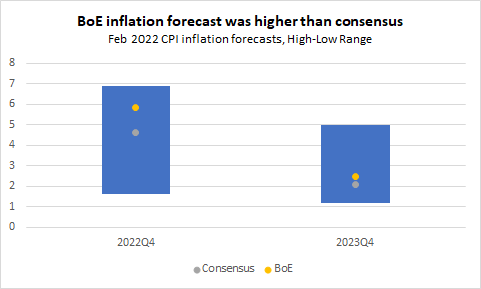
The elephant in the room, however, is why it was felt that such a review was required in the first place. The answer, to put it bluntly, is that it was designed to keep politicians off the BoE’s back after it was accused of failing to predict the huge rise in inflation in 2022 (true) and the fact that its policy response was too slow (less true). In fact, the BoE's inflation forecast in February 2022 was above that of the consensus, predicting end-2022 inflation at 5.8% versus a consensus expectation of 4.6% (outturn: 10.8%) and end-2023 inflation at 2.5% versus the consensus prediction of 2.1% (outturn: 4.2%). Thus, while the BoE forecast was a significant under-estimate, it was less so than most forecasters.

As for the policy response, as I (and many others) have noted previously there was little anyone could have done to prevent an inflation spike in the face of an external oil price shock. Recall that the UK had just come off the back of a pandemic which had resulted in the steepest decline in output in 300 years and whose long-term effects were at that time still unknown. It did not feel like the right time for a sharp tightening of monetary policy. However a review of process is a standard response to issues that are more a matter of policy. Simply put, it is a way to deflect attention.

Another issue worth addressing is the question raised by the Sunday Times economics editor David Smith as to why it took an external review to highlight these shortcomings, which were well known internally. We are very much in speculative territory here, but since Bernanke took a lot of evidence from BoE insiders – past and present – it is hard to avoid the conclusion that this review offered an opportunity to tackle internal inertia. This may be the result of senior managers lack of knowledge of the issues involved; the fact that their attention has been diverted by other policy matters in recent years (Brexit, the pandemic) or simply a lack of budget resources. Either way the Review is a good way to get their attention.

Last word

It is always a good thing to review forecast models and processes, especially when they have been in place for so long and the Bernanke Review put the BoE’s process under a lot of scrutiny. In many ways it simply came across as a call to modernise a system, which in the grand scheme of things was already pretty decent but perhaps had been neglected a little over the past decade. However, the one thing it will not fix is that the future is inherently unknowable. No matter how state of the art, no forecasting system can cope with the kind of shocks to which we have been subject of late. Give it another decade and we will be having this debate all over again.

Wednesday, 30 November 2022

The DSGE paradigm: Do Stop Generating Errors

From RBC to DSGE

The recent passing of Ed Prescott, the 2004 Nobel Laureate in economics, was a cause for sadness across the economics profession. Prescott was universally recognised as a revolutionary thinker in the field of macroeconomics and one of his great innovations (along with fellow Laureate Finn Kydland) was the introduction of so-called Real Business Cycle (RBC) models. In simple terms, these models postulate that business cycle fluctuations arise as a result of labour supply decisions in response to stochastic shocks. One of the consequences of this paradigm is that business cycles are optimal responses to productivity shocks and that interventions to offset such shocks are harmful because they cause the economy to deviate from its long-run optimal path.

The first attempt to produce an economic model based on these principles was Prescott’s 1986 paper ‘Theory Ahead of Business Cycle Measurement’ which was very much based on calibrated responses rather than one which used statistical techniques to fit the data. It was also a model which assumed a world in which there were no distortions. Unsurprisingly, Keynesian economists did not take the RBC conclusions lying down. They argued that the economy was characterised by frictions such as nominal rigidities, the existence of monopoly power and information asymmetries which can result in involuntary unemployment, thus opening up a role for governments to smooth the cycle. In response, the so-called New Keynesians devised a model paradigm which required the imposition of a number of restrictive assumptions in order to approximate the world as they saw it.

Thus did the literature on New Keynesian Dynamic Stochastic General Equilibrium (DSGE) models come into being: Dynamic because they operate over very long (infinite) horizons; Stochastic because they deal with random shocks and General Equilibrium because they are built up from microfoundations. Such models now dominate much of the academic thinking in the modelling and policy literature. But they are mathematically complex, opaque and founded on a series of assumptions that calls into question whether they have anything useful to contribute to the future of macroeconomics[1].

What’s not to like? Quite a lot as it happens!

In the words of Olivier Blanchard, “there are many reasons to dislike current DSGE models” particularly because of the apparently arbitrary nature of the assumptions on which they are based. For example, aggregate demand is based on infinitely lived households which are assumed to have perfect foresight. Show me one of those and I will give you some hen’s teeth. Furthermore, the inflation equation is based on a forward looking equation that does not take any account of inflation persistence. But perhaps the most contestable features of DGSE models is their slavish adherence to microfoundations. These attempt to embed economic behaviour patterns that are invariant to a particular state of the world. This allows macroeconomics to escape from the charge posed by the Lucas critique that the parameters of any model change as circumstances change – a criticism of the models in operation in the 1970s, and which was perceived to be one of the reasons why they performed so badly in predicting the recessions of the time.

There is a lot wrong with this way of thinking. For one thing, the microfoundations are based on the behaviour of representative agents. In other words, they impose a theory of how individual firms and households act and assume that we can scale this up to the wider economy. As one who grew up using models based on aggregate data, it has always struck me as odd that we should discard much of the richness inherent in the observational evidence of macro data. An interesting theoretical paper published in 2020 makes the more subtle point that for the representative agent to mimic the preference structure of the population requires the imposition of extreme restrictions on the utility function used to describe household behaviour. The supreme irony of this is that the DSGE revolution was able to capture the intellectual high ground because the structural modelling paradigm that it replaced was unable to counter the criticism levelled in Chris Sims’s classic 1980 paper that such models relied on “incredible” identifying assumptions.

A further thought is that we have little evidence that the utility functions of representative agents are invariant over time, as modern macro theory assumes. But whilst there is no doubt that the research underpinning the macro revolution in the late-1970s and early-1980s – including the influential work of Lucas – is intellectually persuasive, the evidence of this year alone, in which inflation spiked to 40-year highs unforeseen by most models in 2021, does not persuade me that the DSGE revolution has significantly enhanced the thinking in modern macro.

By this point you have probably gathered that I am highly sceptical of much of the work conducted in modern macro modelling in the last 40 or so years. This is not to deny that it is intellectually fascinating and I am more than happy to play around with DSGE models. But as Anton Korinek points out in this fascinating essay, “DSGE models aim to quantitatively describe the macroeconomy in an engineering-like fashion.” They fall victim to the “mathiness” in economics, of which Paul Romer was so scathing.

And their forecasting performance is poor

We might be more accepting of the DSGE paradigm if it produced significantly better forecasting results than what went before. The events of the past 15 years suggest that this is far from the case and it is now generally acknowledged that the out-of-sample forecasting performance of DSGE models is very poor. If this does not render them useless as a forecasting tool, it suggests that they are no better than the structural models which the academic community has spent forty years trying to knock down. Proponents will argue that this is not what they are designed to do. Rather they are designed to understand how the economy is constructed around the deep-seated parameters underpinning household and corporate decision-making which allows for policy evaluation.

This debate was brought into sharp focus recently following the publication of a fascinating paper on the properties of DSGE models which is less concerned about whether they represent good economics but whether they represent good models in a statistical sense. The answer, according to the authors, is that they do not. The paper can get quite dense in places but one of the things it does is to examine how well it can fit nonsense data. By randomly swapping the series around and feeding them into the DSGE model, “much of the time we get a model which predicts the [nonsense] data better than the model predicts the [actual] data.” They draw the damning conclusion that “even if one disdains forecasting as an end in itself, it is hard to see how this is at all compatible with a model capturing something – anything – essential about the structure of the economy.”

Last word

As one who for many years has used models for forecasting purposes that have been sniffily dismissed by the academic community, it is hard to avoid a sense of schadenfreude. Blanchard offers us a way out of this impasse, arguing that theoretical models of the economy have a role to play in “clarifying theoretical issues within a general equilibrium setting ... In short, [they] should facilitate the debate among macro theorists.” By contrast, policy models of the type with which I am most comfortable, “should fit the main characteristics of the data” and be used for forecasting and policy analysis. 

There is some merit in this argument. By all means continue to tinker with DSGE models to see what kinds of insight they can generate but do not let them anywhere near the real world until their forecast performance substantially improves. In the words of statistician George Box, “all models are wrong but some are useful”. And some are DSGE models.


[1] For an excellent introduction to many of the issues in modern macro, check out this free online textbook ‘Advanced Macroeconomics: An Easy Guide’ By Filipe Campante, Federico Sturzenegger and Andrés Velasco